Manual Handoffs Cost More Than Engineering Hours
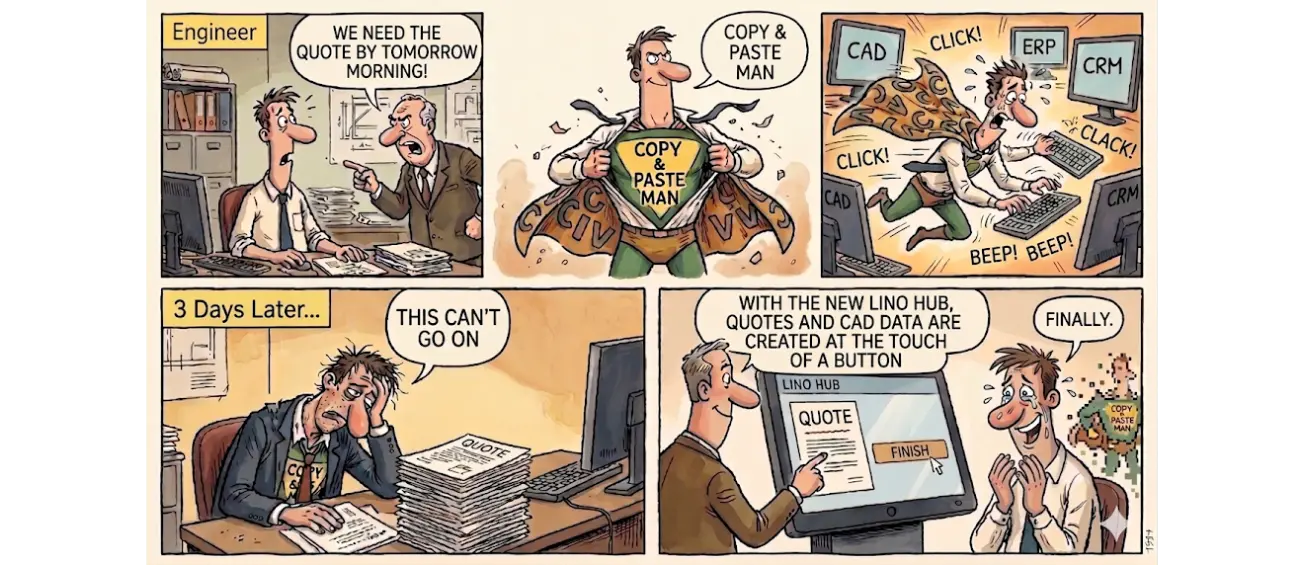
Organizations in mechanical and plant engineering that deal daily with the same product data being maintained separately across CAD, PDM, ERP, and CRM systems know the consequences: errors that propagate through the entire order processing chain and engineers spending their time on routine tasks rather than advancing product development. According to an internal analysis of Lino customer projects, up to 30% of all errors in typical engineering processes originate from redundant, manual data entries between systems. These errors are not the result of insufficient diligence — they are the result of a process architecture built on manual data transfer.
Engineering Automation addresses this challenge directly: a data-driven automation solution that integrates seamlessly into the existing system architecture and connects four essential automation layers into a continuous process chain.
What Engineering Automation Means in Practice
Engineering Automation refers to the rule-based digitization of technical workflows — from the configuration of highly variable products through automated CAD engineering to the error-free transfer of bills of materials and manufacturing data to ERP and PDM systems. The four layers of this architecture operate in systematic conjunction:
- Configuration Automation translates complex product variants into rule-based configuration logic. CPQ systems (Configure, Price, Quote) automatically generate quotations based on technically and commercially validated data. For the first time, sales and engineering operate from a shared data foundation.
- Design Automation automatically generates 3D CAD models, 2D drawings, and bills of materials from configuration outputs. Product knowledge is encoded once into rule sets that validate, document, and output every variant — eliminating repetitive workload for the engineer.
- Integration Automation connects CAD, CAM, CPQ, PDM/PLM, ERP, and CRM through a central platform, the Lino® Hub. Bidirectional data flows and standardized connectors ensure that no information is entered twice or transferred manually.
- Intelligent Automation extends the rule-based logic with AI-powered agents that support requirements capture, design optimization, and process control. All automation decisions remain explainable, auditable, and compliant — with Human-in-the-Loop as an architectural principle.
Why Conventional System Integration Falls Short
System integration connects systems and enables data exchange. What it does not govern is how connected systems behave under real-world complexity. As soon as a sales representative configures a custom variant not covered by any standard template, the automated workflow breaks down – and an engineer takes over manually.
Engineering Automation establishes a superordinate definition layer: product logic is formulated once and subsequently executed consistently across all involved systems – regardless of whether execution takes place in CAD, CPQ, PDM, or ERP. The result is deterministic, traceable processes that remain manageable even under high variant diversity.
A practical example: a conveyor technology manufacturer with more than 2,000 active product variants reduced its quotation lead time by 40% following the implementation of an Engineering Automation architecture. The engineering department processed the same order volume with 25% fewer resources, as routine tasks were automated and capacity was freed up for development work.
Measurable Value in Under 30 Days
A common objection to automation projects is implementation time. Lino addresses this concern with a modular approach: standardized software building blocks, proven industry templates, and a clearly scoped proof of concept with a guaranteed outcome enable measurable productivity gains in fewer than 30 days. Scaling to additional use cases and business areas follows in incremental steps.
Key performance indicators measured across completed projects: 25–50% shorter lead times, over 30% fewer engineering errors, 99.9% system availability.