


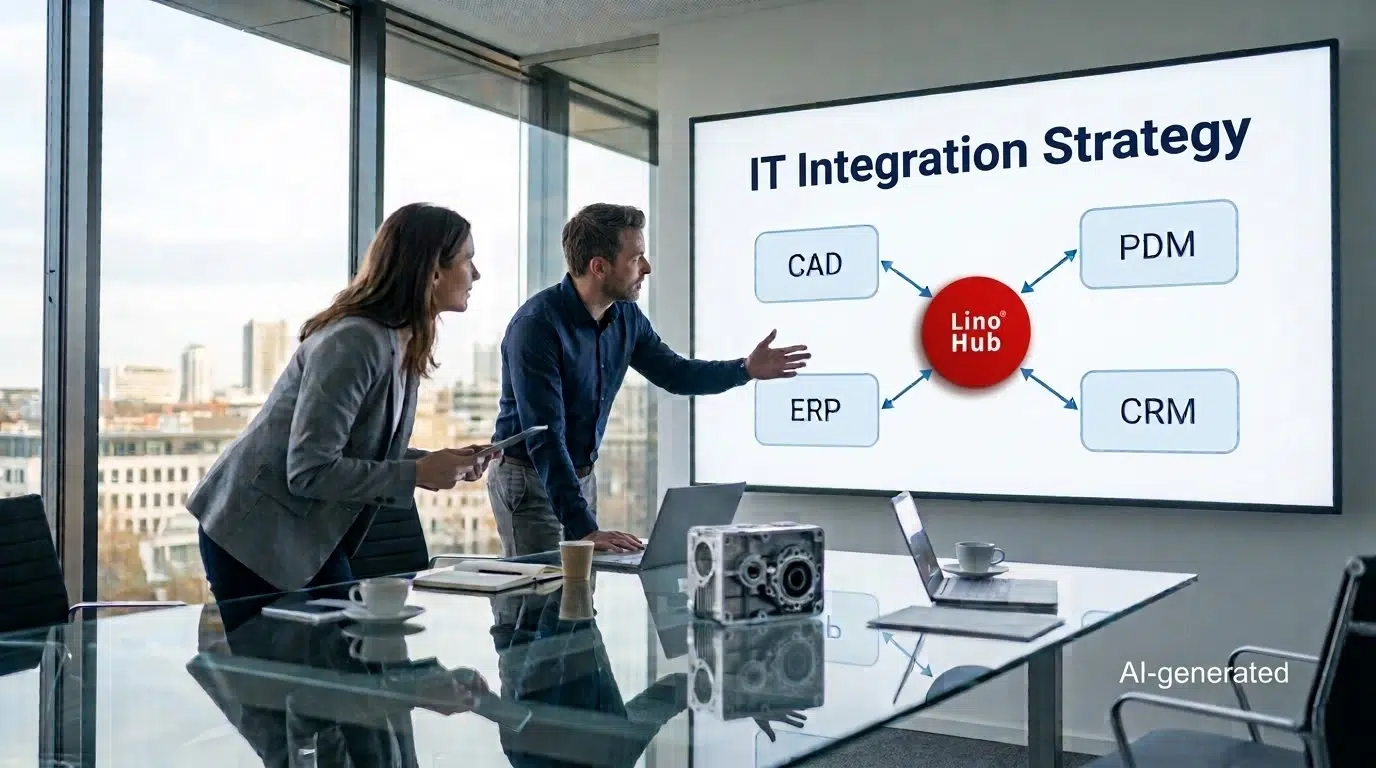
Every new interface costs the company twice
The IT project budget pays for an interface exactly once. After that, operations foots the bill: with every update, every system change and every employee who leaves the company. Anyone who treats interfaces purely as project costs overlooks the second bill.
The first bill is in the project plan
Building an interface is predictable: requirements, implementation, testing, acceptance. It has a budget and an end date. That is why a connection between CAD and ERP or between PDM and CRM initially seems inexpensive, especially when a department handles it itself with a script or an Excel spreadsheet.
The second bill arrives during operations
Once the interface is accepted, ongoing operations begin. Every update to either system requires interface testing, every change to the data model requires adjustments, and whoever built the interface must still be available years later. These costs appear in no project plan, but in every operating budget.
Illustrative calculation, not measured data: Four directly interconnected systems mean six connections; six systems mean fifteen; eight systems mean twenty-eight. Every one of these connections generates both bills.
Proprietary interfaces make the second bill unpredictable
If interfaces are undocumented and proprietary, only the integration provider can modify them. The provider then dictates the price and timing. The lock-in is therefore not in the ERP system, but in the interface. Meanwhile, departments create isolated solutions because there is no approved platform. IT leadership later has to take on the operation of this shadow IT as well.
Pay for one layer instead of twenty-eight connections
A central integration layer needs one connection per system: with eight systems, that means eight instead of twenty-eight. All existing systems remain in use. Lino® Hub connects CAD, PDM/PLM, ERP, CRM, PIM, and web and shop systems through standardized, documented, bidirectional interfaces.
IT decision-makers choose the deployment model: SaaS, on-premises or hybrid. As the manufacturer, Lino handles update and release management. Data flows remain auditable, and Lino checks AI outputs deterministically against a set of rules before allowing them to proceed.
The test: Does engineering know what its designs cost?
Engineering shows how far integration really goes. It supplies items and bills of materials to the ERP system, but receives no information on manufacturing costs, stock levels or project status in return. A data flow that runs in only one direction is an export, not integration. With Lino® Automate, the CAD system queries the ERP system directly: costs and stock levels are displayed during the design process. Design release creates the production order and routing, records engineering time and notifies production planning. This works without programming, through configuration alone, so IT has no custom code to maintain.
Webinar on November 19, 2026: A model to take away
Lino will demonstrate what this looks like live using Odoo as an example on Thursday, November 19, 2026, from 10:30 to 11:00 a.m. The model applies to any ERP system with a REST or SOAP interface, including SAP, proALPHA and abas. IT administrators can assess it as a template for their own integration: Which data flows back into engineering, and which steps can be covered through configuration rather than code? The webinar will be held in German; an English translation will follow.
Register here: Connecting CAD and ERP: Lino Automate with Odoo


